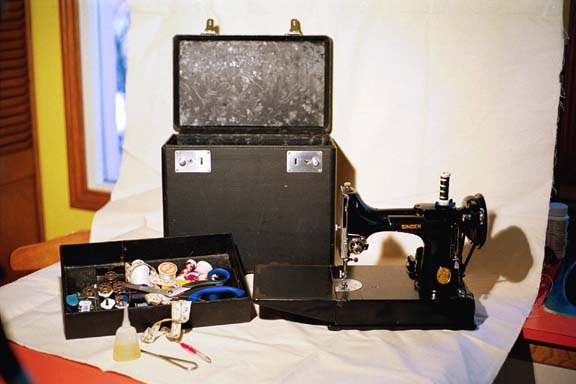
My FW's story tracks that of my mom, who met a handsome Candian soldier on the team liberating Belgium from Nazi occupation in 1944. Five of her aunts and uncles had been taken to the death camps to be murdered.
They married, he brought her to Canada, and bought the Feather (or perhaps it was a wedding gift?) during a brief time in Toronto before moving back to his family's village of Barrington Passage, Nova Scotia.
Three years later she was suddenly widowed, with infant Michael and two-year-old Gary, in a big house with inlaws a couple miles away, barely speaking English. She supported herself and my half-brothers with that Featherweight, doing alterations and making dresses, for many years until she married my father, an itinerant welder who rented one of her spare rooms. But that's another story.
This Featherweight is scratched, its decals are worn where she steadied her hand on the bed, the handwheel is very chipped and the stitch length indicator has a deep notch worn at "10" where she flipped it up and back for a million backtacks. It wasn't babied the for the first fifty years of its life; it carried a family instead.
My mom says I learned to sew on this machine shortly after I learned to walk, and she used it for paid work, clothes for us, repairs and hobbies her entire adult life; in the 1980s she once again made money with it making clothing and accessories for a local folk-y craft-y fashion house.
My dad gave me the FW when she passed and I realized that the ka-KLUNK of the presser bar lever being flipped and the Grrrrrrr of the motor starting, are comfort sounds from my childhood. Hearing them means my mom is nearby.
The FW is tiny; its carrying case measures just 12" high, 13" wide, and 8" deep including a tray for thread, scissors, sewing kit, tools and accessories. It's an amazing piece of 1930s engineering and much-loved by quilters, generally regarded as the best for "piecing;" it does the nicest straight stitch of any machine ever built, is quiet and vibration-free, and is very portable. Mom's machine's serial number indicates that it was built shortly after October 28th, 1947 in St. John's, Quebec.
When I got it, I gave it a thorough cleaning and oiling, and it sews as well as when it left the factory. I've used it for repairs, making Hallowe'en and party costumes, and lots of small sewing projects.
|
In April 2003 a couple of very good friends sold me their Featherweight 222K, which is what I now use for most projects. here is its web page.
|
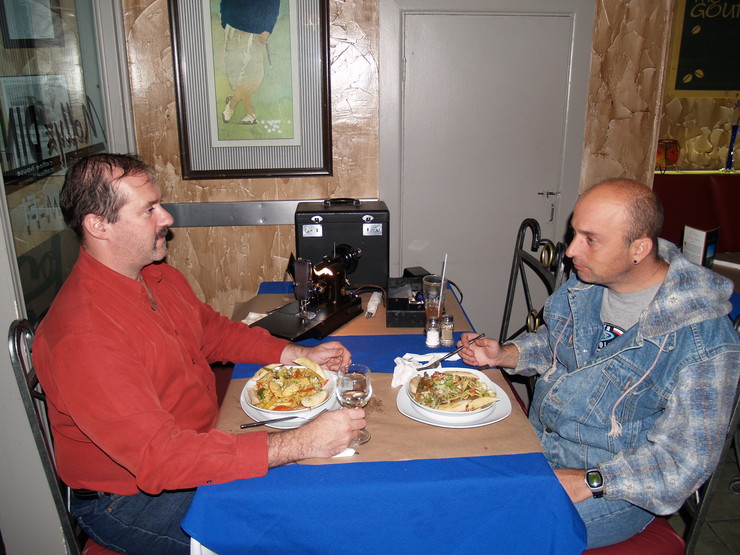
2007-10-28: Mike and I take Heddy's FW to Mollyz to celebrate its 60th birthday. |